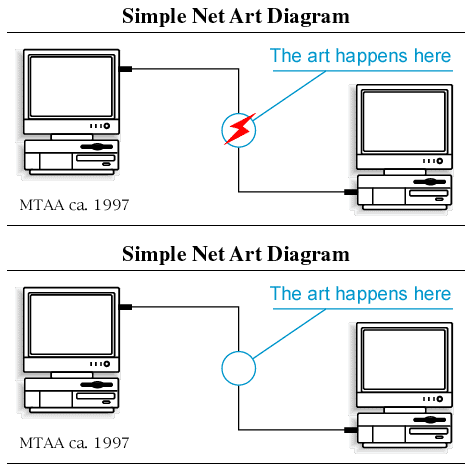
MTAA Reference Resource, Simple Net Art Diagram (1997).
META
"...a metamedium, whose content would be a wide range of already-existing and not-yet-invented media."
-Alan Kay & Adele Goldberg
Old media can be inserted and reconfigured within digital space and become something else and new. For example, you can digitize a text, then cut, copy, paste, find...analyze it with a computer.
Adele Goldberg
mimicking lofi aesthetics by Rosa Menkman
New media also consists of not yet invented media, software and hardware that reinterpret it. Examples of this might be social media, 3D scanning, MMORPG, etc.
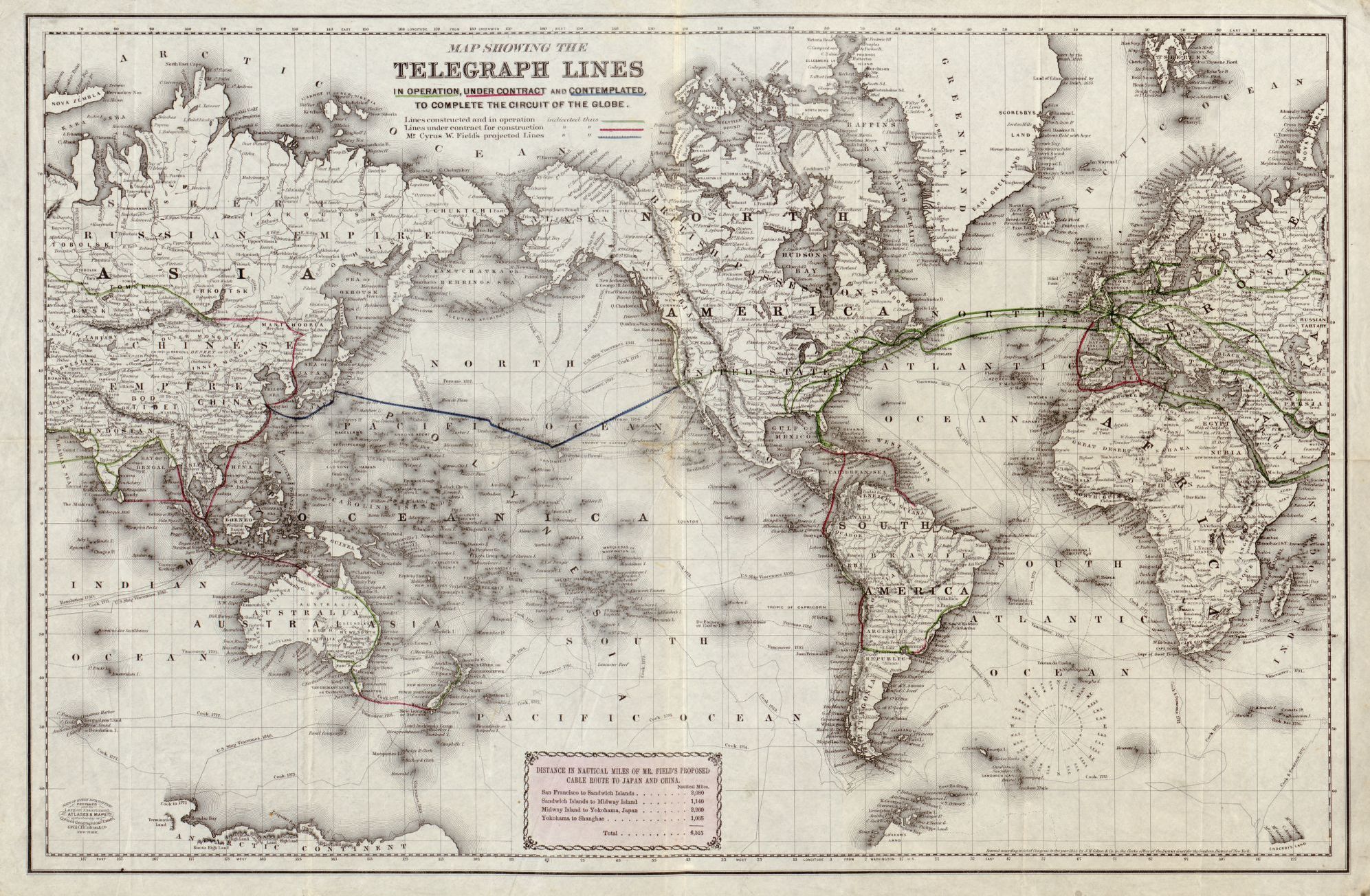
An early example of analog meta-media is the telegraph to telephone. The map above, from 1871, shows how copper wire connected
the world with the telegraph network. The telegraph was the first electronic mass communication device, but it used Morse code
to send and translate messages with a complicated series of electrical dashes and dots. Just like the telegraph, the telephone
uses electricity and can use the preexisting infrastructure of the telegraph, but is a completely new media. As Adele Goldberg
states above, the telephone example consists of “..already-existing and not-yet-invented media.”
"new media” is “new” because new properties (i.e., new software techniques) can be easily added to it.
-Lev Manovich
Primarily known for his silk screen paintings, in this video Andy Warhol uses a computer to add new techniques to his aesthetic.
In his book "The Language of New Media, Manovich draws parallels to way cinema, particularly Dziga Vertov's early avant-garde film "Man with A Movie Camera" (1929), and digital systems work.
Such as:
Games v alternate perspectives in films
Database system used in Vertov's film with how most digital content is stored and analyzed.
Non-linear story telling such as montage
Principles of New Media
From The Language of New Media by: Lev Manovich
Numerical Representation: "All new media objects, whether created from scratch on computers or converted from analog media sources, are composed of digital code; they are numerical representations."
New Media == 01001110 01100101 01110111 00100000 01001101 01100101 01100100 01101001 01100001
Modularity: "Media elements, be they images, sounds, shapes, or behaviors, are represented as collections of discrete samples (pixels, polygons, voxels, characters, scripts). These elements are assembled into larger-scale objects but continue to maintain their separate identities. The objects themselves can be combined into even larger objects—again, without losing their independence."
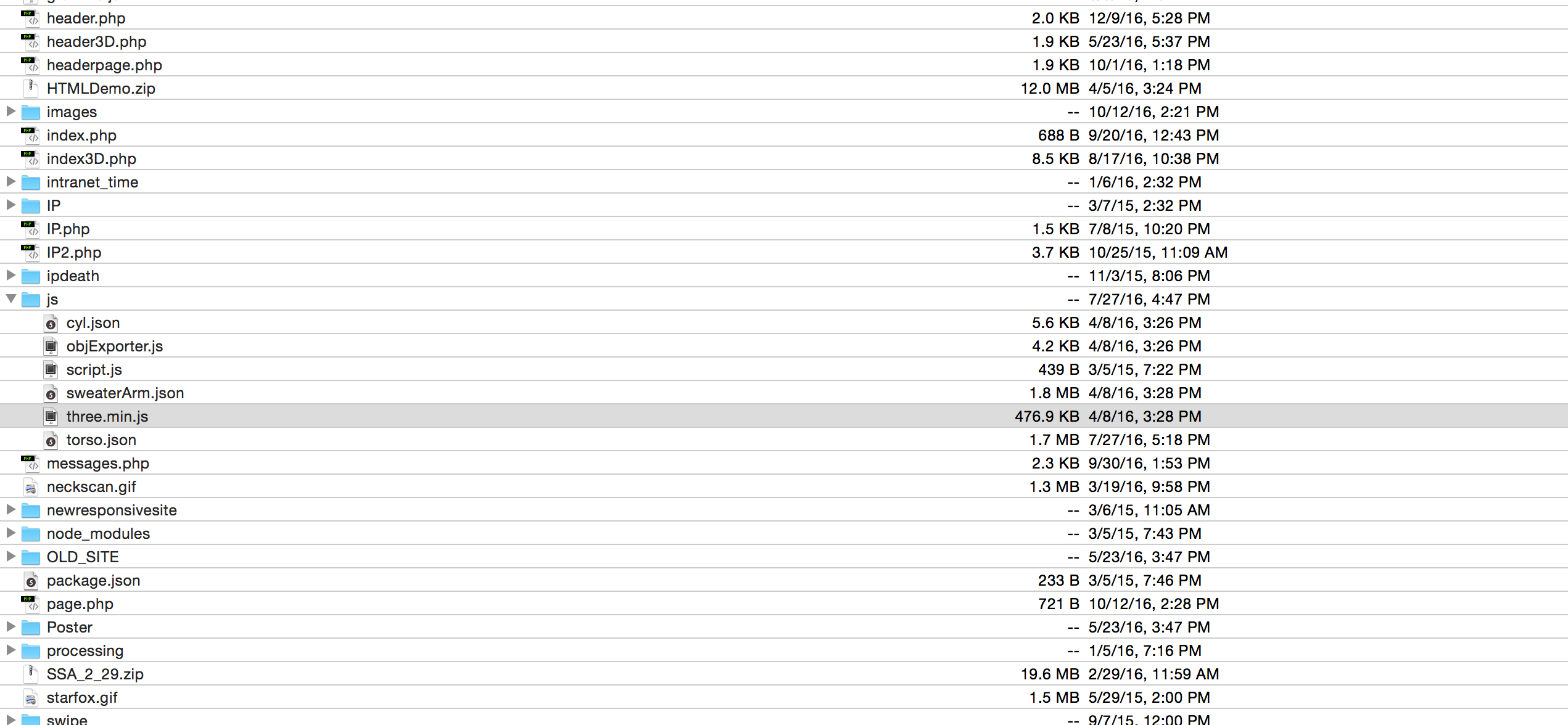
This image shows some of the files that make up my website, listing them in alphabetical order.
My website as a single entity is created using most of these files, but they still exist
individually. For example, an image that is used to create my website can still function as an
image on its own.
Automation: "The numerical coding of media (principle 1) and the modular structure of media objects (principle 2) allow for the automation of many operations involved in media creation, manipulation and access."
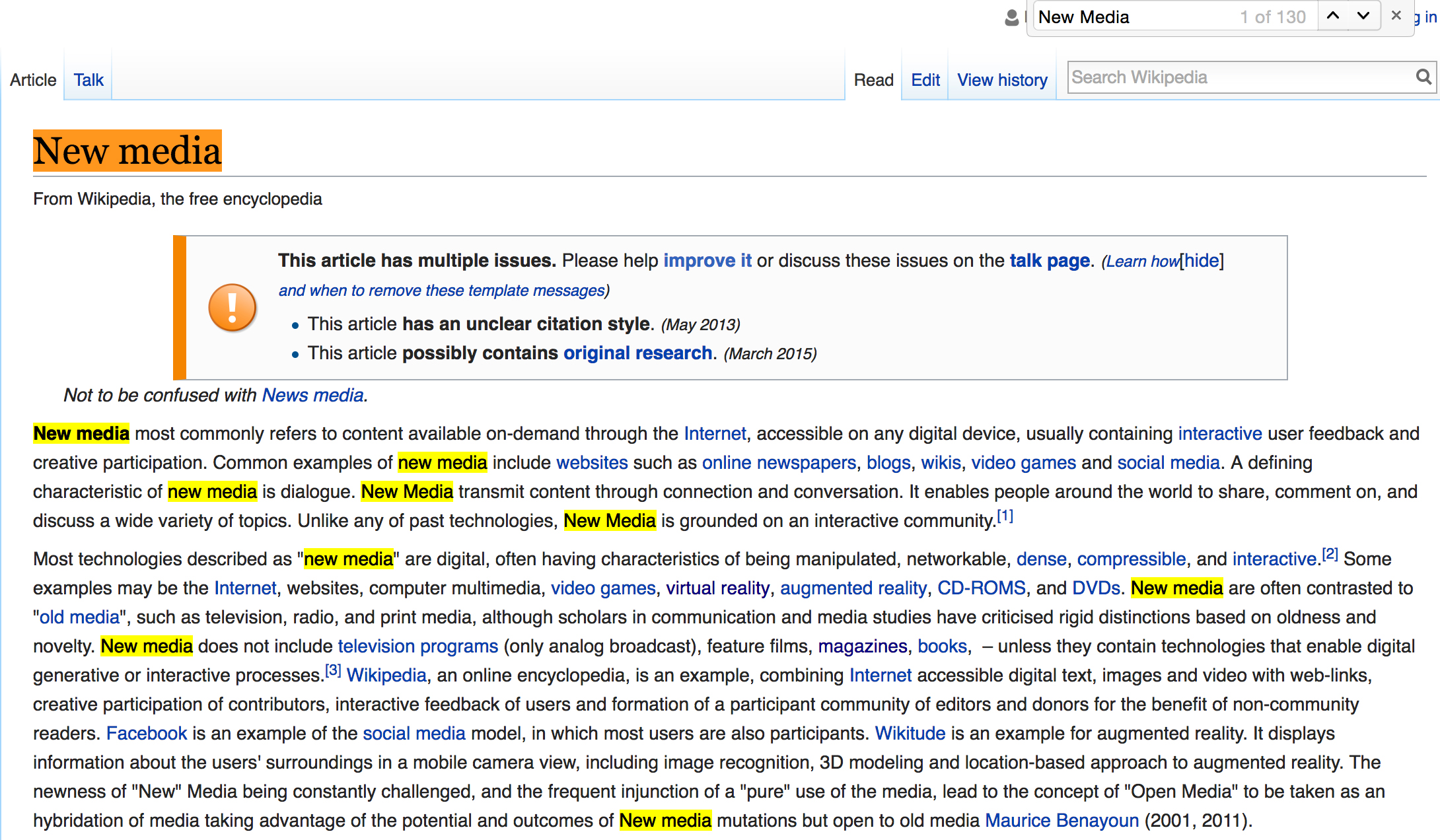
Because this Wikipedia entry for New Media is digital and all of the words, letters and numbers exist on their own,
we can use the Find tool to focus on one phrase and automate the finding of it.
Variability: "A new media object is not something fixed once and for all, but something that can exist in different, potentially infinite versions. This is another sequence of the numerical coding of media (principle 1) and the modular structure of a media object (principle 2)."
"New Media art and older categorical names like "Digital art," "Computer art," "Multimedia art," and "Interactive art" are often used interchangeably, but for the purposes of this book (class) we use the term New Media art to describe projects that make use of emerging media technologies and are concerned with the cultural, political, and aesthetic possibilities of these tools. We locate New Media art as a subset of two broader categories: Art and Technology and Media art. Art and Technology refers to practices, such as Electronic art, Robotic art, and Genomic art, that involve technologies which are new but not necessarily mediarelated. Media art includes Video art, Transmission art, and Experimental Film art forms that incorporate media technologies which by the 1990s were no longer new. New Media art is thus the intersection of these two domains."
-Mark Tribe & Reena Jana
New Media can be a contentious name because it is always changing and adapting. It's a fluid development.
"new media art is not defined by the technologies discussed here: on the contrary by deploying these technologies for critical or experimental purposes, New Media artists redefine them as art media."
-Mark Tribe & Reena Jana
Using media from various resources, new media artist Cory Arcangel uses video games, TV shows, YouTube clips, default software
tools, devices and sculpture to comment on the contradictions, influences and expectations of contemporary digital life.
New Media Environments (We Love New Media and Corporations Love Us)
"An iPhone is not technology, it's packaging and conventions. [...] Your software choices are like any addiction or religion, they want your loyalty and they want your money and they want you to think like them. [...] it's culture politics masquerading as technology"
-Ted Nelson
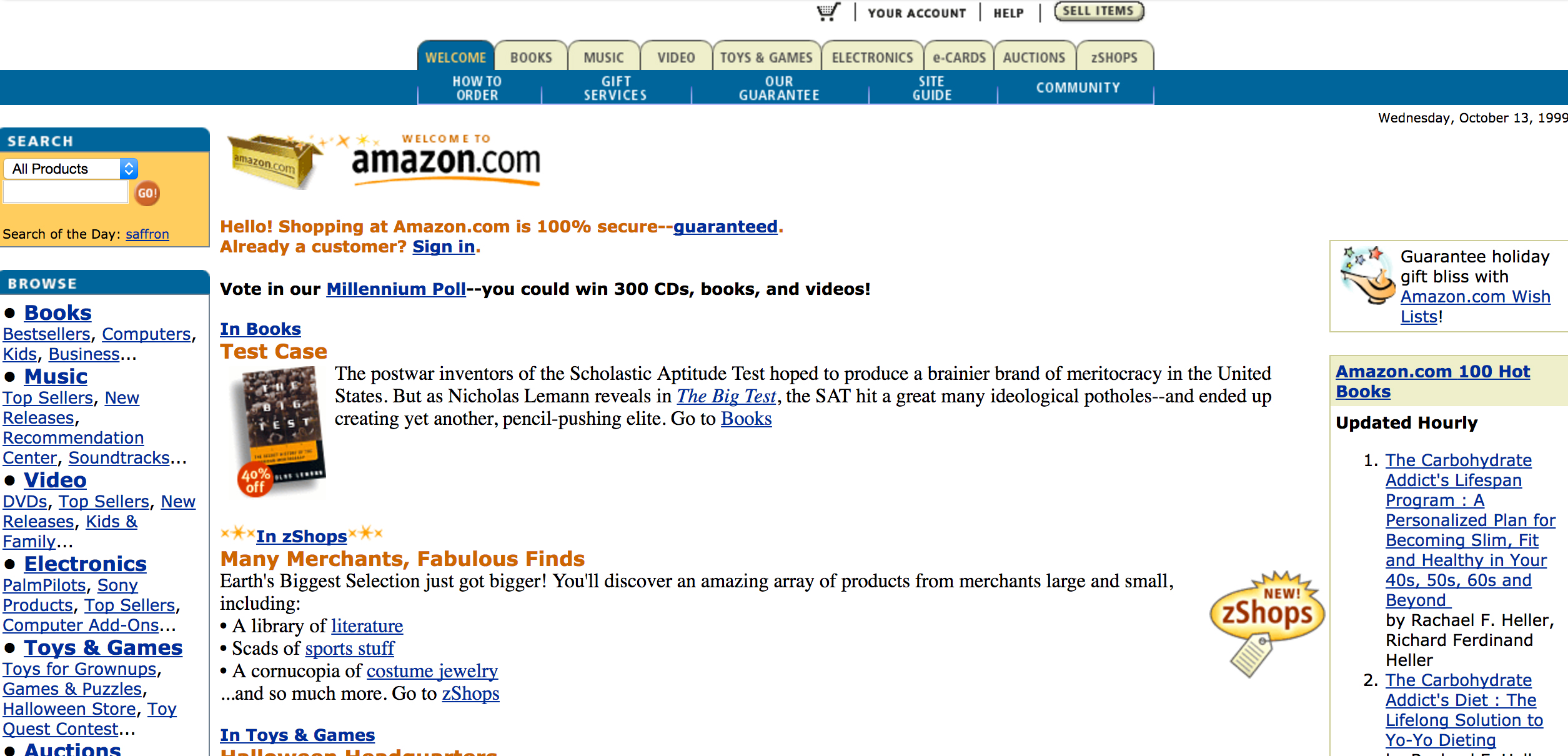
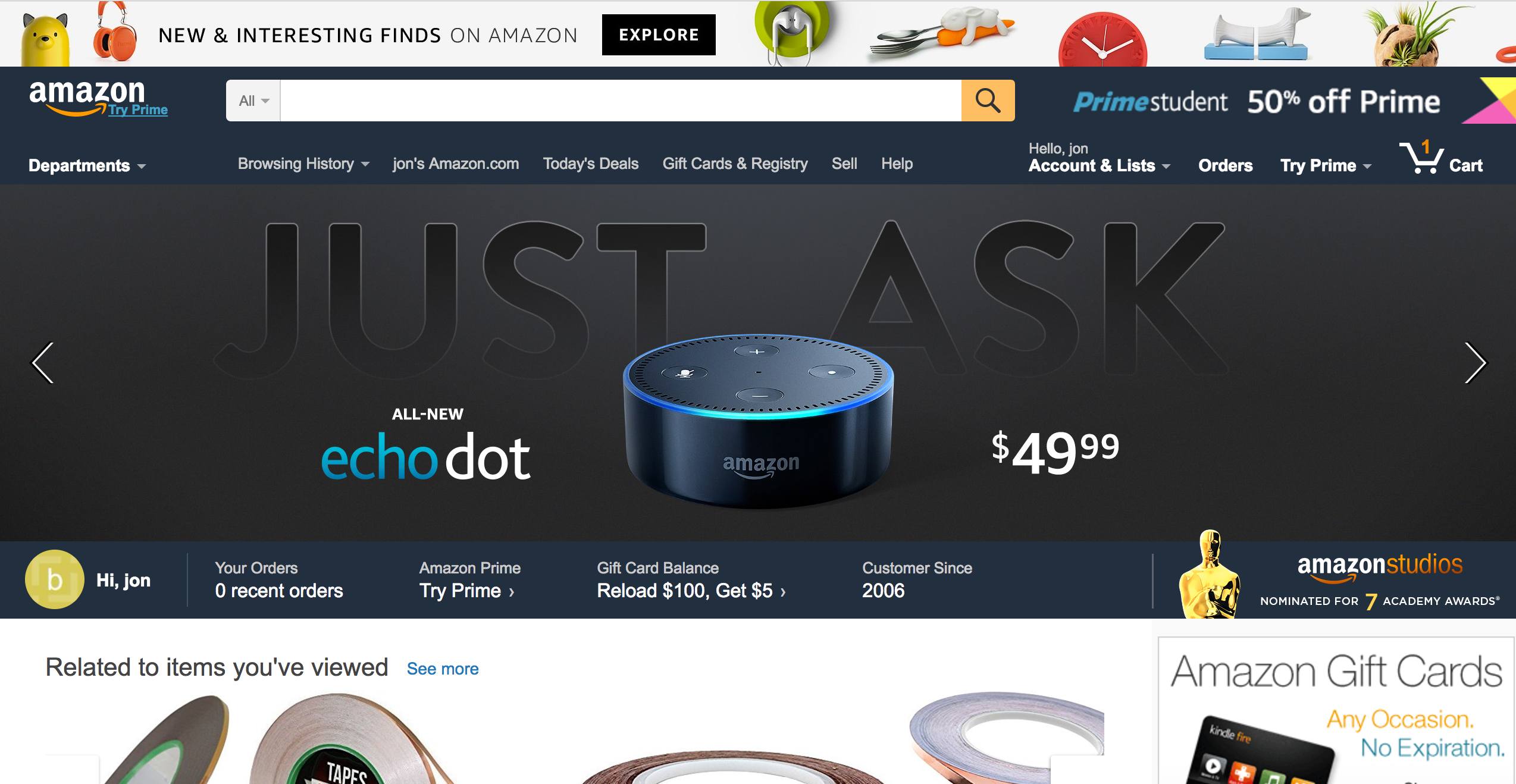
Software and digital tools are not neutral; they are embedded with the ideologies and politics of their creator. Whether that be completely free and open sourced software (HTML), a controlled and automated space (Facebook), or controlled hardware (Apple).
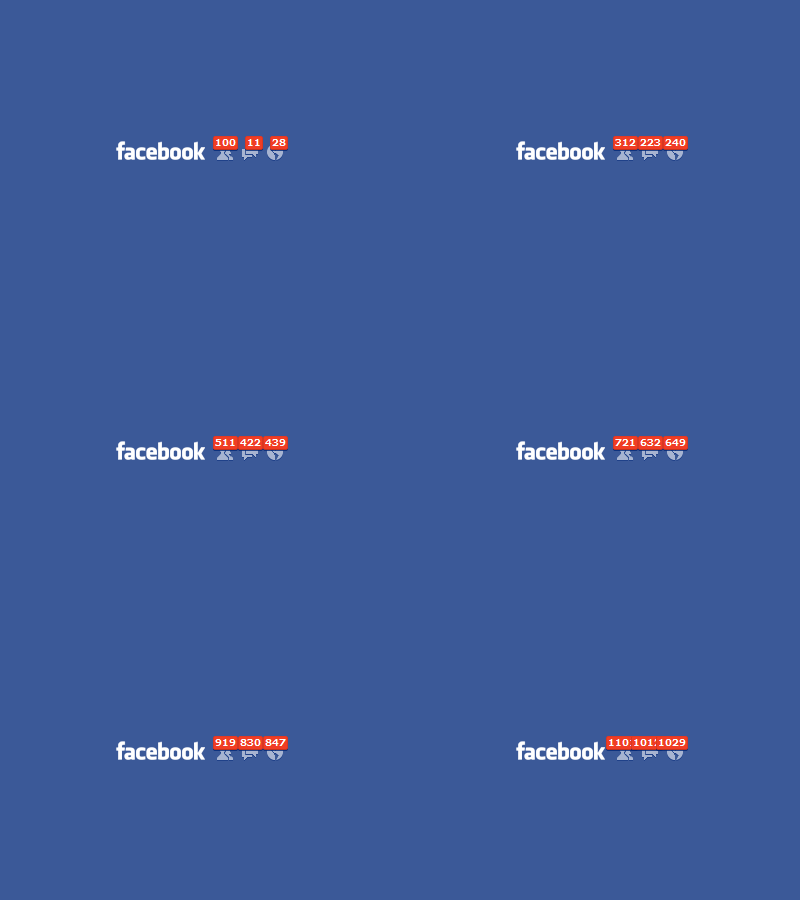
"We Facebook users have been building a treasure lode of big data that government and corporate researchers have been mining to predict and influence what we buy and for whom we vote. We have been handing over to them vast quantities of information about ourselves and our friends, loved ones and acquaintances."
"Everything we do in the digital realm - from surfing the Web to sending an e-mail to conducting a credit card transaction to, yes, making a phone call - creates a data trail. And if that trail exists, chances are someone is using it - or will be soon enough."
-Douglas Rushkoff
Facebook Bliss by: Anthony Antonellis
"All media work us over completely. They are so persuasive in their personal, political, economic, aesthetic, psychological, moral, ethical, and social consequences that they leave no part of us untouched, unaffected, unaltered. The medium is the massage. Any understanding of social and cultural change is impossible without a knowledge of the way media work as environments. All media are extensions of some human faculty – psychic or physical.”
-Marshall McLuhan
The Posthuman Condition
"If my nightmare is a culture inhabited by posthumans who regard their bodies as fashion accessories rather than the ground of being, my dream is a version of the posthuman that embraces the possibilities of information technologies without being seduced by fantasies of unlimited power and disembodied immortality, that recognizes and celebrates finitude as a condition of human being, and that understands human life is embedded in a material world of great complexity, one on which we depend for our continued survival.”
From: How We Became Posthuman
By: Katherine Hayles
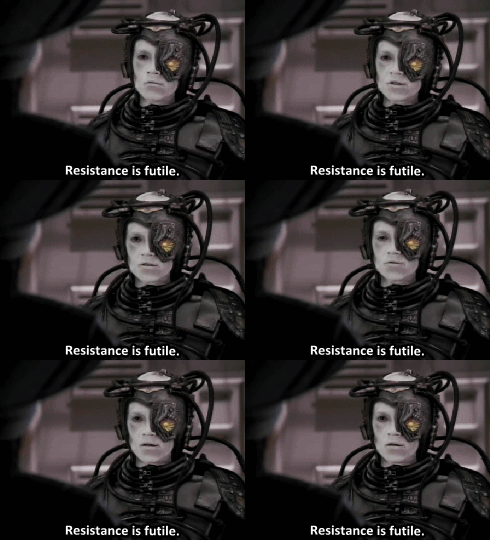
“By the late twentieth century, our time, a mythic time, we are all chimeras, theorized and fabricated hybrids of machine and organism; in short, we are cyborgs.”